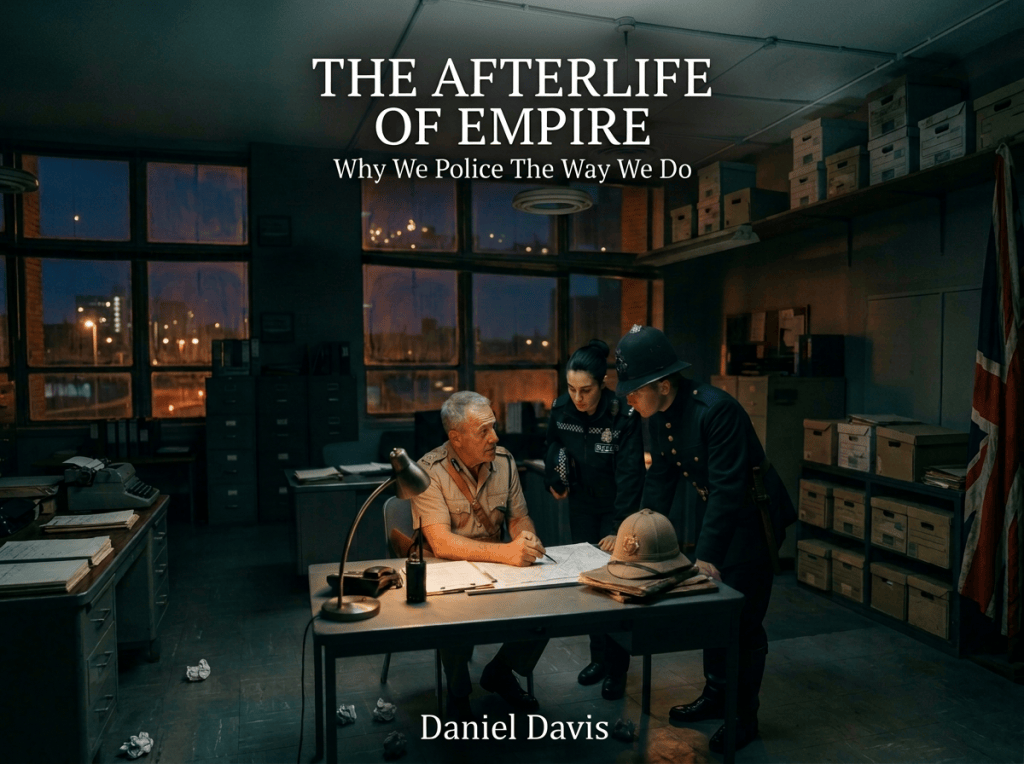
Empire, Race, and the Making of Modern Policing

Introduction
Modern policing did not emerge from neutrality, fairness, or universal consent. It was born from the need to control the working poor, the colonised, and later, Britain’s racialised communities at home. This volume uncovers the hidden foundations of British policing: the myths that protect it, the imperial machinery that shaped it, the racial logics that sustain it, and the social hierarchies it continues to enforce.
Laying the historical foundation for the rest of the series, Volume 0 traces how policing was invented to manage disorder rather than crime. How empire served as a testing ground for coercive techniques, how race became embedded in policing’s operational DNA, and how class and poverty were framed as forms of danger. It explores how colonial tactics came home to govern protest, how those tactics survived decolonisation and embedded themselves across British institutions, and how today’s disparities in stop and search, gang databases, predictive policing, and the differential provision of protection are the measurable afterlife of that history.
The volume ends with the lived realities of over-policing and under-protection, and a bridge chapter showing how the same logics now operate across institutions beyond policing. This prepares the reader for Volume I, where fear replaces empire as the primary engine of policing power.
Why This History Matters
The end of empire did not end its way of thinking. Ideas about danger, hierarchy, and control once used to justify ruling colonised peoples, became part of British policing culture. They show up in public order tactics, stop and search, risk assessments, and modern data systems, shaping everyday experiences of policing, trust, and harm.
These chapters help practitioners understand why mistrust, disproportionality, and institutional harm remain persistent features of British policing. Showing that today’s injustices have deep historical roots, and why reforms that ignore those roots keep producing the same outcomes under different names.
What This Volume Covers
o.1 — “The Invention of the Police: Myths, Motives, and the Machinery of Control ”
The police were created to control the dangerous classes. — Daniel Davis.
We are often told that British policing is built on consent. The idea that the police serve the public with trust and agreement. This chapter challenges that story, showing that the Metropolitan Police was not created as a neutral public service but as a tool to control the poor, unruly, and those seen as politically dangerous. And traces the Thames River Police, the Peelian myth, and Victorian roots of pre-emptive suspicion that still shape policing today.
0.2 — “The Imperial Boomerang: How Overseas Tactics Came Home”
Ideas don’t travel on their own. People carry them. — Daniel Davis
Ideas don’t stay where they’re invented — they travel. This chapter explores how strategies first used overseas returned home to shape British policing in the nineteenth and twentieth centuries. It examines how imperial tactics of population surveillance, intelligence gathering, public-order management, and pre-emptive control were imported to deal with domestic unrest, protest, and marginalised communities, tracing the specific channels through which that transfer happened
0.3 — “The Racial Infrastructure of Policing: Empire’s Logic at Home”
“Race is the modality in which class is lived.” — Stuart Hall.
Racism was not incidental to empire, it was infrastructural. This chapter examines how colonial administrations created racial categories to justify who could be policed, restricted, or surveilled, and traces how those logics crossed into domestic policing long before Britain became visibly diverse. It shows how racialised assumptions became embedded in institutional memory, professional culture, and the everyday habits through which policing decisions are made. And why they have proven so resistant to reform.
0.4 — “The Dangerous Classes: How Victorian Britain Invented an Internal Enemy”
‘The ignorant classes are the dangerous classes.’ — Henry Ward Beecher
Before crime problems, there were “dangerous classes.” This chapter shows how nineteenth-century Britain labelled poor and migrant communities as threats to order, producing early forms of criminalisation that echoed imperial thinking, fused class anxiety with racial othering, and created the domestic template for suspicion-based policing that colonial governance then refined and returned. It traces how the dangerous classes concept evolved through successive vocabularies without ever changing its governing logic.
0.5 — “Policing Protest: From Colonial Rebellion to British Streets”
‘The empire’s most enduring export was not goods or governance. It was a way of responding to dissent.’ — Daniel Davis
Techniques used abroad to quell dissent came home to police democracy. This chapter explores how methods developed against colonial uprisings; kettling, infiltration, pre-emptive arrest,and intelligence-led disruption, reappeared in Britain’s responses to protest movements. Demonstrating how the colonial premise that dissent is disorder rather than democratic participation continues to shape public order policing today, it examines specific cases from the Poll Tax riots to Black Lives Matter, to show the colonial framework in operation.
0.6 — “The Afterlife of Empire: Why Colonial Policing Still Shapes Britain”
‘Empires end on paper long before they end in practice.’ — Daniel Davis
Colonialism didn’t simply end, it mutated. This chapter traces how the administrative habits, institutional cultures, and governing frameworks formed in empire embedded themselves in British domestic institutions during decolonisation, and how they have been transmitted through successive generations of practitioners as professional common sense. It also examines how the politics of denial has prevented honest public reckoning with this inheritance. And why that denial shapes the institutional responses to criticism documented across successive inquiries.
0.7 — “Over-Policed and Under-Protected: How Racism Still Shapes Policing in Britain”
‘If you are Black in Britain, you are more likely to be treated as a suspect when you need protection — and ignored when you ask for it.’ — Daniel Davis
This chapter brings the historical argument into the present tense, documenting the specific forms through which over-policing and under-protection operate in contemporary Britain — stop and search disproportionality, adultification bias, the inadequate investigation of racist violence, and the self-reinforcing erosion of legitimacy. It shows through specific cases including Stephen Lawrence, Belly Mujinga, and Child Q, that these are not individual failures, but expressions of the structural pattern the preceding chapters have traced. And suggests that over-policing and under-protection are not separate problems but paired outcomes of the same colonial logic.
0.8 — “The Logics of Disorder: How Disorder Became a Governing Tool in Modern Britain”
‘The police are not here to create disorder. They’re here to preserve disorder.’ — Richard J. Daley
Disorder is often treated as a breakdown to be managed. But this chapter asks a different question: what if disorder is also produced? It identifies three distinct logics through which disorder has functioned as a political instrument across the history traced in Volume 0 — disorder as threat, disorder as defiance, and disorder as destabilisation — and shows how these logics now operate not only in policing but across education, healthcare, employment, safeguarding, and immigration enforcement. Its central claim is that the state does not simply respond to disorder. It constructs disorder in order to respond.
0.9 — “From Policing to Harm: How Colonial Logics Migrate Across Modern Institutions”
‘Racism is a structure, not an attitude.’ — Daniel Davis
History doesn’t just echo, it reappears. This bridge chapter links Volume 0 to Volume I by showing how the colonial logics traced across the preceding chapters have migrated beyond policing into the broader institutional landscape of British public life. Drawing on Shereen Daniels’ 30 Patterns of Harm framework, it highlights how silencing, disproportionate scrutiny, unequal protection, and process as punishment appear across education, healthcare, workplaces, and social care. Setting the stage for the next Volume’s examination of how these inherited logics are activated through crisis narratives and the politics of fear.
Practitioner Briefs
Each Practitioner Brief translates the chapter’s critical analysis into concise, applied guidance aimed at helping practitioners recognise the governing logics examined in the series and respond to them with greater clarity and professional confidence.
Bridge to Volume I
Volume 0 ends with a bridge chapter connecting the historical foundations of policing to contemporary institutional evidence. This sets the stage for Volume I, which turning to media, moral panic, crisis narratives, and the politics of fear, examines how the inherited logics of colonial governance are continuously renewed through the construction of new threats, new folk devils, and new emergencies.
Together, these volumes show how power works through stories, systems, and the management of public fear. What looks like a crisis is often not new, but the continuation of much older patterns.
About the Series
Governing The Crisis is written by Daniel Davis, a researcher and commentator on social justice and policing.
Continue to Chapter 0.1 — The Invention of the Police — Myths, Motives, and the Machinery of Control
Explore The Full Series: Governing Through Crisis
Follow & Subscribe: LinkedIn | Bluesky | Twitter