O.2 — The Imperial Boomerang: How Overseas Tactics Came Home (Part 4)

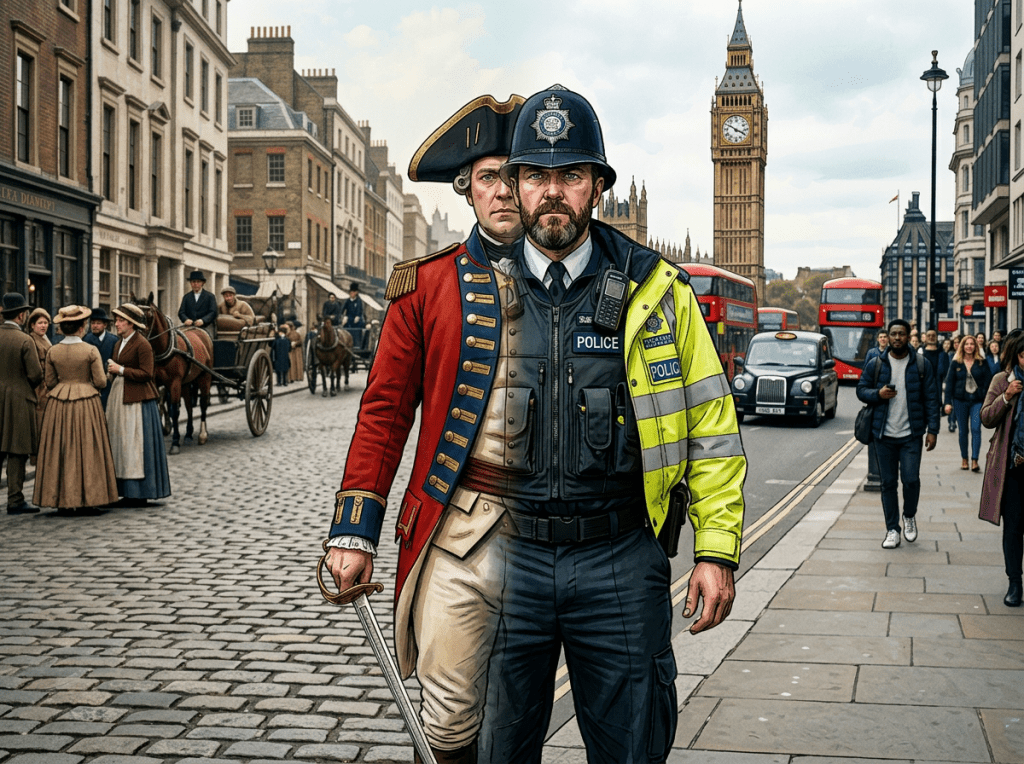
Half of a man dressed in 18th-century British officer uniform with a sword, half in modern London police uniform standing on a London street with Big Ben and double-decker buses in the background.

Empire did not end; it came home in the minds of its officers. Daniel Davis

Colonial Thinking, Domestic Policing

What happens to an institution when the empire that shaped it disappears?

The formal end of empire didn’t produce a clean break. It transferred a migration of people, assumptions, habits, and professional identities (from the colonies) back to Britain.  The officers, administrators, and policymakers who had spent careers governing subject populations didn’t retire their worldviews when they came home, they brought them into the institutions waiting for them: the constabularies, the Home Office, the intelligence services, and public order units. And through those institutions, the colonial way of seeing the world — who was dangerous, who was suspicious, who required managing, what counted as disorder, when force was legitimate — became embedded in the professional culture of British policing.

Part 4 examines how that embedding happened. How colonial logics shaped Britain’s own urban governance, and what structural legacies that process left behind.  These aren’t historical footnotes; they’re the foundations of patterns that persist today.

A Policing Identity Built for Empire

The officers who returned from colonial service had been shaped by environments in which the relationship between police and public was one of authority over subjects rather than service to citizens.   Dissent was treated as danger and difference was treated as risk.  Order meant obedience — the law was a tool of rule rather than a framework of rights.  Force wasn’t a last resort, it was a routine feature of daily policing, calibrated to the population being governed rather than constrained by their consent.

Colonial officers surveilling crowd before unrest, tense atmosphere

When these officers took up roles in British constabularies, they brought this professional worldview with them.  It shaped hierarchical, authoritarian leadership styles intolerant of internal criticism.  It shaped attitudes toward community demands — suspicion of scrutiny, resentment of oversight, a tendency to interpret accountability as an attack rather than a democratic requirement.  And it shaped the culture of public order units in particular, where the colonial model of rapid, coordinated, pre-emptive force felt more like professional common sense than a colonial import.

Most importantly, this worldview didn’t depend on direct colonial experience to reproduce itself.  Officers who never served overseas absorbed it through training, command structures, organisational folklore, and the informal mentoring through which professional culture is transmitted from one generation to the next.  Empire became embedded not only in policy but in professional instinct.  An inherited set of assumptions about populations, risk, and authority that felt self-evidently correct because it had always been there.  This is how institutional memory works: not through deliberate transmission, but through the quiet normalisation of what has always been done.

Britain’s Internal Colonies: Urban Districts as Zones of Control

The colonial officer didn’t disappear when empire ended.  He was absorbed into the domestic police force, and his a ssumptions travelled forward through the officers he trained, and the officers they trained in turn.

By the late nineteenth and early twentieth centuries, Britain’s own urban poor were being governed through methods that bore a striking resemblance to colonial administration.  This wasn’t consciously imported, but the near‑inevitable outcome of the assumptions they carried.

Seven boys in old-fashioned clothes talking with three policemen on a Victorian street

Class had become a category of suspicion, poverty had become coded as deviance, and when these domestic trends merged with colonial policing’s emphasis on surveillance, pre-emption, and collective control, Britain effectively created internal colonies — urban districts that were not governed as communities deserving of service, but as populations requiring management.

Neighbourhoods like Whitechapel, Liverpool’s Toxteth, Glasgow’s Gorbals, and Birmingham’s Handsworth were subject to intense, continuous policing.  This wasn’t because crime rates necessarily justified it, but because their residents were perceived as politically unstable, culturally different, or economically unpredictable.  The policing logic was colonial: constant patrolling, intelligence collection, disruption of gatherings, pre-emptive intervention, and aggressive public order responses to any sign of collective action.  These weren’t communities being served, they were populations being monitored and contained.

Young men were the primary target.  Empire had long categorised young men in colonised territories as inherently volatile — requiring discipline and supervision.  At home, this logic resurfaced in the moralisation of working-class youth, the early juvenile court system, the criminalisation of street life, and recurring panics over hooliganism that punctuated the late nineteenth and early twentieth centuries.  

When young Black Britons arrived in significant numbers in the post-war decades, they entered a policing system already primed to view young men in urban spaces as a problem, and found that the colonial lens had simply refocused on them. Migrants from the Caribbean, Africa, and South Asia settling in Britain after the Second World War didn’t encounter a neutral institution learning to adapt, they encountered one already equipped with a framework for governing racialised populations as collective threats.

People disembarking ship Empire Windrush at Tilbury Docks with suitcases
Passengers from the Empire Windrush disembark at Tilbury Docks, marking the start of the Windrush generation in Britain.

The colonial logic shifted its target from overseas subjects to racialised citizens, but the structure of that logic remained intact.  Surveillance, collective suspicion, disproportionate force, and the treatment of entire communities as crime sources were not new responses to new populations, they were familiar methods redirected. Patterns which, over time, hardened into structures built into the design of British policing itself.  Part 5 examines those structures and the legacies they left behind.

For how racialisation became the central organising principle of domestic policing, see chapter O.3

Bridge: Part 4 → Part 5

Part 4 has shown how colonial thinking travelled home. How the assumptions, habits, and professional identities formed in the empire were absorbed into British policing, redirected toward new populations, and normalised as common sense.  The argument is clear in outline, but an outline needs structure behind it.

Part 5 moves from the transmission of worldview to the architecture it produced — examining how those inherited assumptions hardened into institutional design, and continue to shape policing today.

Part 5 explores:

  • how preventive, suspicion‑led policing became a built‑in feature of British practice
  • how a racialised map of danger was embedded in categories, criteria, and risk frameworks
  • how public order policing adopted a model rooted in control rather than dialogue
  • and how an institutional self‑image resistant to scrutiny became one of policing’s most durable legacies

From the minds that came home to the structures they built.

About the Series

By Daniel Davis | Researcher and Commentator on Policing and Social Justice. 

Continue to Part 5 — Colonialism’s Structural Legacies

Explore The Full Series: Governing Through Crisis
Follow & Subscribe: LinkedIn | Bluesky | Twitter