Colonialism’s Structural Legacies
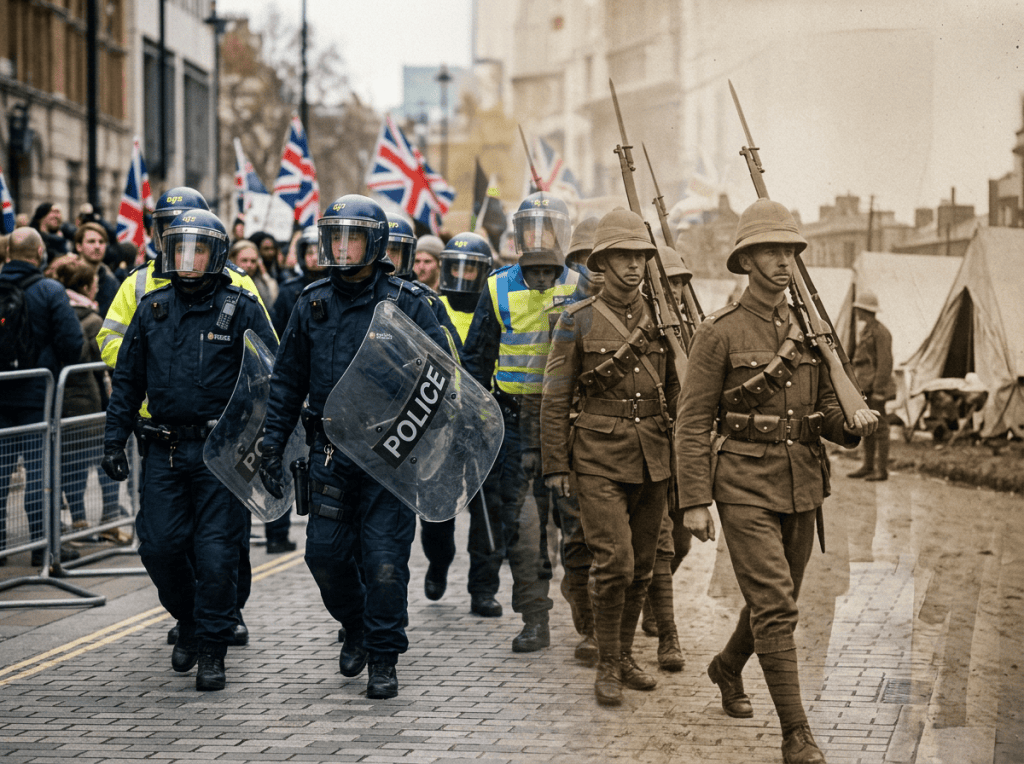
British policing inherited its public order model from the policing of empire. The structures that emerged from this inheritance were the product of decades in which colonial assumptions were treated as professional common sense and built directly into the priorities and operating logic of policing.
By the mid‑twentieth century, these assumptions had hardened into a set of durable frameworks: ways of defining risk, managing populations, interpreting disorder, and responding to scrutiny that, embedded in its institutional design, have persisted across reforms, inquiries, and changing political climates.
Part 5 examines those frameworks, the legacies they produced, and the consequences they continue to generate today.
1. A preventive, suspicion-led model
Colonial policing was never primarily reactive. It was built on the anticipation of threat, early intervention, the disruption of organisation before it could consolidate, and the monitoring of potential rather than actual danger. This preventive mindset persists in stop and search, Section 60 powers, Prevent, intelligence categorisation, predictive tools, and gang databases — all of which treat potential risk as sufficient grounds for intervention. The colonial legacy here is not simply a set of tactics, but a foundational assumption that the job of policing is to pre-empt disorder rather than respond to harm.
2. A racialised map of danger

Empire taught the British state to associate danger with certain bodies and communities and to read race as a proxy for risk. This association did not require explicit racist intent to operate. It was embedded in the categories, criteria, and professional habits through which policing decisions were made. Its persistence is visible in the consistent disproportionality of stop and search, in the over-policing and under-protection of Black communities, in adultification bias in schools and courts, and in the algorithmic discrimination increasingly documented in data-driven policing tools. These aren’t aberrations, they are the system working as designed.
3. A public order model rooted in control, not dialogue
Colonial crowd management was built on containment, demoralisation, and rapid coordinated action. On the premise that the crowd had no political standing and the state had no obligation to negotiate. This model shaped domestic public order policing in ways visible across more than a century of British history, from the policing of the 1926 General Strike to the Battle of Orgreave, from the management of the 1981 uprisings to the kettling of student protesters in 2010. In each case, the underlying assumption is colonial: that disorder is a problem of populations to be controlled, not a signal of grievances to be heard.

4. An institutional self-image resistant to reform
Colonial policing was designed to defend the state, not to be accountable to those it policed. It cultivated a professional identity built on loyalty, hierarchy, and the management of external criticism as a threat rather than a democratic resource. This legacy, a deep suspicion of oversight, a defensive response to scrutiny, a preference for internal resolution over external accountability, is one of the most durable and damaging inheritances of the colonial model. As O.1 noted, it is visible in the Metropolitan Police’s responses to the Macpherson Report and the Casey Review — responses characterised more by defensiveness than by genuine institutional reckoning. The question of how that resistance to reform operates in practice, and what it costs, is taken up in Volume II and Volume III.

What This Means for Practitioners
The four legacies described above are not abstractions, and shape the daily working environment of everyone employed within or alongside policing institutions — the frameworks used to assess risk, the command cultures that govern decision-making under pressure, the assumptions about communities that inform operational priorities, and the institutional responses to criticism that determine whether reform is genuine or cosmetic.
For practitioners, the most important insight from this part is perhaps the least comfortable: these legacies do not require individual prejudice to operate. An officer does not need to hold consciously colonial attitudes to make decisions shaped by colonial assumptions. Those assumptions are embedded in the training, the risk frameworks, the institutional culture, and the professional common sense that practitioners absorb simply by working within the system. This is what institutional memory means in practice, unreflective inheritance rather than deliberate reproduction.
It’s not about assigning blame, it’s about developing the critical awareness that makes genuine change possible. The ability to ask, when making a decision, not just whether it follows procedure, but where the procedure came from, and whose interests it was originally designed to serve.
The Turn Toward Race
The structural legacies described in this part did not operate in a vacuum. They operated on specific populations, at specific historical moments, with specific consequences. And as Britain changed, as decolonisation proceeded abroad while migration transformed the population at home, those legacies found new targets.

By the time significant numbers of Caribbean, African, and South Asian migrants had settled in British cities, the institutional machinery was already in place. The categories were ready, the surveillance frameworks existed, the assumptions about which communities were dangerous, which neighbourhoods required intensive management, and which populations were inherently risky, had been built into the system long before those communities arrived. What changed wasn’t the logic, but the people it was applied to.
This is where O.2 hands the argument to O.3. The racial infrastructure of British policing wasn’t created in response to a diverse society. It was imported from empire, and embedded in domestic institutions — waiting for the populations that empire had produced to follow empire home.
Conclusion: The Minds That Came Home
Colonial policing transferred to Britain through three channels: the people who had practised it, the institutions that adopted its methods, and the professional culture that reproduced its assumptions in officers who had never set foot in a colony. Together, these channels ensured that the end of empire did not mean the end of imperial governance, but its relocation.
The internal colonies that emerged in Britain’s industrial cities, the preventive and suspicion-led policing model that governed them, the racialised map of danger that determined who bore the greatest weight of the system, and the institutional resistance to reform that has frustrated change across decades are all legacies of the colonial transfer examined in this chapter. They are not failures of individuals or isolated moments. They are structural features built over time, that continue to shape policing outcomes today.
Part 6 examines what happened as empire formally ended, and why the infrastructure it had built into British policing proved so much more durable than the empire itself.
Bridge: Part 5 → Part 6
Part 5 has shown how colonial assumptions hardened into institutional frameworks — how preventive policing, racialised risk, control‑based public order, and resistance to scrutiny became built‑in features of British practice. The argument is clear in structure. But structure alone does not explain consequence.
Part 6 turns to what happened when these frameworks met a changing Britain, When decolonisation abroad and migration at home reshaped the population, and the inherited machinery of policing found new targets.
Part 6 explores:
- how the end of empire altered Britain’s social landscape
- how policing frameworks designed for colonial subjects were applied to new citizens
- how racialisation became the organising logic of domestic policing
- and why the infrastructure of empire proved more durable than empire itself
From the structures that endured to the consequences they produced.
About the Series
By Daniel Davis | Researcher and Commentator on Policing and Social Justice.
Continue to Part 6 — The End of Empire… Without the End of Its Infrastructure
Explore The Full Series: Governing Through Crisis
Follow & Subscribe: LinkedIn | Bluesky | Twitter