O.3 — The Racial Infrastructure of Policing: Empire’s Logic at Home (Part 1)

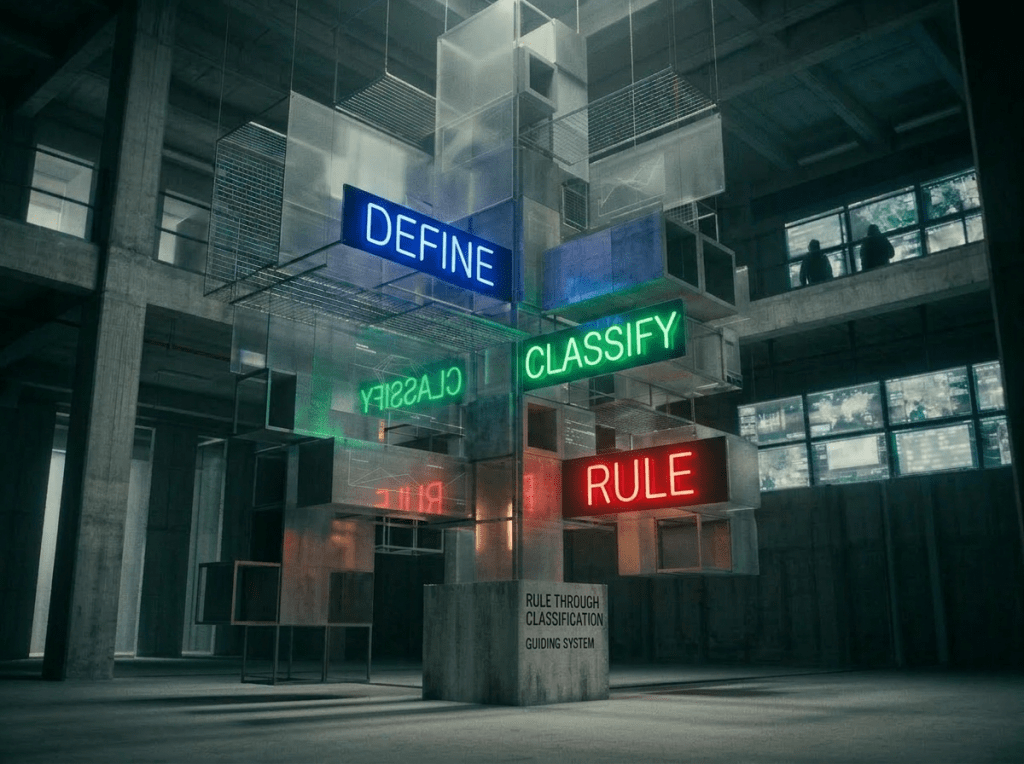
Three neon signs: Define, Classify, Rule

“The past is never dead. It’s not even past.” — William Faulkner

Define, classify, rule: Race as a Governing Strategy

The previous chapters traced how modern British policing emerged through two intertwined forces: the management of the poor at home and the governance of empire abroad.  This chapter brings those threads together by examining what sat at the centre of both — the construction of race as a tool of governance.

Race, in the imperial context, was not an innocent description of human difference.  It was a technology of rule; a way of sorting populations, allocating suspicion, and justifying unequal treatment at scale.  The British Empire relied on racial categories to determine who required surveillance, who could be trusted, who was naturally threatening, and who needed to be contained.  And as O.2 established, those categories did not remain overseas.  When empire declined, they were carried home by the people who had used them, were embedded in the institutions that had relied on them, and naturalised into the professional common sense of domestic policing.

This chapter examines how that process worked.  How race was manufactured as a governing category in the colonial context, how it crossed into domestic policing, and how it became embedded in the institutional memory of British police forces in ways that persist long after the explicit language of empire has disappeared.

How Empire Manufactured “Types” of People

Governing vast colonial populations with relatively few officials required a solution to a practical problem: how do you manage millions of people you cannot individually know? The answer, developed across decades of colonial administration, was what political theorist Mahmood Mamdani calls rule through classification.  Rather than governing individuals, colonial administrators governed populations: defined, sorted, and managed according to racial and ethnic categories that the colonial state itself had largely created.

The process began with definition. Colonial officers compiled lists, hierarchies, and descriptions of tribes, races, and communities, often exaggerating, distorting, or inventing differences in the process.  These labels sorted people into lasting groups: “martial races” deemed disciplined and militarily useful; “criminal tribes” treated as hereditarily predisposed to offending; “volatile” or “ungovernable” groups requiring intensive surveillance; and “loyal subjects” whose cooperation was rewarded with relative protection. These weren’t neutral observations, they were administrative decisions written into laws, census forms, policing manuals, and enforced through the daily operations of colonial institutions.

The second step was the translation of prejudice into policy.  Once a group was labelled dangerous or unreliable, that perception shaped everything: patrol patterns, levels of surveillance, intelligence gathering priorities, use of force thresholds, and decisions about who could move freely and who required restriction.  The administrative judgment became operational truth.  Repeated, reinforced, and eventually treated as self-evident.

The third and most consequential step was the creation of racial common sense.  A way of seeing certain bodies and communities that felt like experience rather than ideology. Generations of colonial officers learned to read populations through frameworks of risk and threat that appeared natural precisely because they were never presented as choices.  By the time empire began to shrink, racialised categories had become practical knowledge: inherited, normalised, and rarely examined.  This is how governing technologies outlast the systems that created them — not necessarily through deliberate preservation, but through the quiet reproduction of what has always been done.

The Colonial Optic: Learning to See Threat

One of the most enduring legacies of empire is what sociologists call the colonial optic.  A framework for interpreting the world that sorts people into categories of trust, danger, and governability before any individual interaction has taken place.  In colonial settings, officers were trained to view entire populations through suspicion because their group identity supposedly made threat inherent, rather than any specific evidenced threat.

Racial Profiling

This framework shaped every level of policing judgment.  It determined how body language was interpreted, whether a person’s manner was read as cooperative or aggressive, calm or excitable.  It shaped risk prediction; the assumption that certain communities were “prone to sudden unrest” based on classification, rather than behaviour.  It influenced moral judgment; the perception of certain populations as lacking discipline or unable to self-regulate.  And it justified collective responses — curfews, raids, and mass stop-and-search operations directed at communities rather than individuals.

The colonial optic did not require conscious prejudice to operate; it worked as professional instinct, activated rather than applied, because the categories were already culturally available.  When later generations of British police officers encountered racialised communities, they did not need to consciously reach for a colonial framework. The framework was simply there, embedded in training, in organisational culture, in the accumulated folklore of the institution.  As Stuart Hall observed, race does not exist biologically, but exists politically.  Policing has always been one of the primary places where that political existence becomes operational, shaping decisions that carry real consequences for real people.

 Bridge: Part 1 → Part 2

Part 1 has shown how race was constructed as a governing technology, manufactured in colonial contexts and embedded in the professional common sense of British policing through a process that required no deliberate preservation to sustain itself.

But ideas alone do not explain structural consequences. Part 2 examines what happened when these racial categories crossed the sea, and when the populations empire had governed abroad arrived in Britain, activating the colonial archive in a new domestic context.

Part 2 explores:

  • how colonial assumptions become professional instinct, transmitted through informal mentoring and institutional culture
  • how inherited racial categories shaped the policing of post‑war migrant communities
  • how the cultural anxieties of post-imperial Britain created the social conditions in which racialised policing felt like common sense
  • and how these frameworks produced the patterns of racialised policing that inquiries later named but could not dismantle

From the logic of race to the moment it came home.

About the Series

By Daniel Davis | Researcher and Commentator on Policing and Social Justice. 

Continue to Part 2:When Racial Categories Crossed the Sea

Explore The Full Series: Governing Through Crisis
Follow & Subscribe: LinkedIn | Bluesky | Twitter