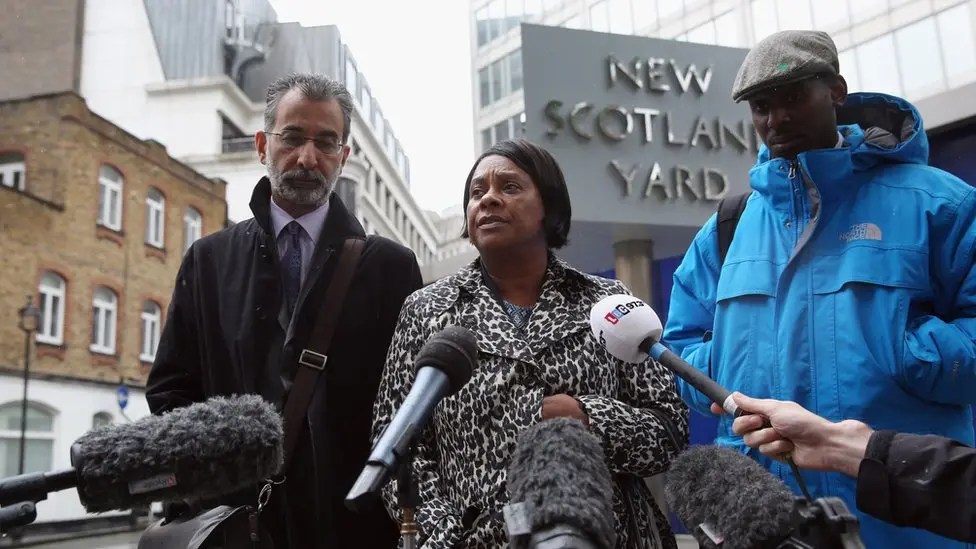
The architecture is extensive. But it has never gone unchallenged — Daniel Davis
The Cultural Backdrop: Belonging, Fear, and the Politics of Otherness
Racialised policing cannot be understood through institutional analysis alone. It’s also sustained by the broader cultural narratives through which British society interprets itself — stories about belonging, order, and national identity that provide the social environment in which policing decisions are made.
The end of empire produced genuine national anxiety. The loss of imperial power, combined with economic uncertainty, deindustrialisation, and rapid social change, created conditions in which questions of cultural belonging became intensely contested. Migration was frequently framed in this context. Not as a social reality to be engaged with but as a cultural threat, a dilution of Britishness, a challenge to stability, an arrival of difference that needed to be managed. These narratives prepared the cultural ground for racialised policing by framing the presence of Black and Asian communities as a problem.
In a society that still imagined itself as culturally homogeneous and historically innocent, Black presence in particular could be read (often unconsciously) as out of place, disruptive, or importing instability from elsewhere. Police behaviour frequently reflected these wider social scripts without officers being aware of it, because the scripts were not presented as racial ideology but as common sense about community, order, and threat.

The result was a feedback loop that colonial governance would have recognised. Community fear generated support for intensive policing. Intensive policing targeted specific populations, reinforcing stereotypes about their criminality. Those stereotypes heightened public fear, producing political pressure for more intensive policing. The loop was self-sustaining because each element appeared to justify the others, as the colonial logic driving it had been successfully rebranded as rational public safety policy.
The Digital Reinforcement of Colonial Logics: How Bias Becomes Automated and Normalised
As Chapter O.2 established, the arrival of digital policing tools has not replaced colonial logics, it has given them new infrastructure. The argument bears brief restatement here because it applies directly to understanding how racialised assumptions become further entrenched in the contemporary period, operating now specifically through racial rather than merely colonial categories.
Predictive policing algorithms are trained on historical police data. As that data reflects decades of racially disproportionate policing, the algorithms learn to predict risk in ways that reproduce the patterns of the past — directing resources toward communities that have historically been over-policed, and generating the data that justifies continuing to do so. The colonial logic of over-policing creating the evidence for further over-policing has not been disrupted by digitisation, it has been automated.

Facial recognition technology carries an additional dimension: studies have consistently found significantly higher error rates for Black and Asian faces, producing disproportionate rates of false matches and wrongful stops among communities that are already over-surveilled. Systems that present themselves as objective, as technically immune to human prejudice, are in practice encoding and amplifying the biases of the historical data they are built on.
Systems like the Gangs Matrix replicate colonial population registers in digital form — classifying individuals and communities under suspicion on the basis of association, neighbourhood, and identity rather than individual conduct. The database presents the colonial logic of group-based suspicion as a technical risk management tool. Giving it a procedural legitimacy that makes it significantly harder to challenge than the explicit racial judgments it has replaced.
Resistance: Communities That Refused
The history of racialised policing in Britain is not only a history of harm imposed and endured. It is also a history of sustained, organised, and often courageous resistance. And that resistance deserves to be understood as part of the analytical picture, rather than an afterthought.
Black communities challenged racialised policing long before official inquiries acknowledged it existed. In 1958, an early example of communities developing their own protective structures in the absence of institutional protection, community defence groups in Notting Hill organised in response to racist attacks that police had largely failed to address. In 1970, the Mangrove Nine, prosecuted following a protest against repeated police raids on a Notting Hill community restaurant, conducted a defence that forced a judge to acknowledge, for the first time in a British court, evidence of racial hatred within the Metropolitan Police. The case was a landmark not because it produced immediate institutional change but because it made visible what the institution had consistently denied.

The Newham Monitoring Project, founded in 1980 in East London, spent years documenting racist attacks and discriminatory policing in the borough — building an evidence base of institutional racism that preceded the Macpherson Report by nearly two decades. Its work demonstrated that the problem was not a matter of isolated incidents or individual officers but of systematic, patterned conduct that could be evidenced, challenged, and brought into public view. Community organisations like the NMP did not simply respond to racialised policing, they named it, mapped it, and refused to allow it to be explained away.
This matters analytically, not just morally. If racialised policing were entirely structural — determined by forces beyond individual or collective agency — then the history of resistance would have nothing to teach. But the fact that communities challenged it, and that inquiries eventually named it, shows that the logics sustaining it are not fixed. They are maintained through institutional choices, cultural narratives, and everyday practices that have been, and can be, contested.

What This Means for Practitioners
For practitioners working within policing and related institutions today, the analysis in this chapter raises a question that is easier to ask than to answer: how do you identify assumptions you have inherited rather than chosen?
The honest answer is that it requires the kind of deliberate reflection that institutional culture rarely encourages. It means asking, when a risk assessment flags a particular individual or community, not just whether the procedure was followed correctly but where the risk category came from and what evidence actually supports it. It means treating the phrase “fits the profile” as a question rather than an answer — asking what the profile is, who constructed it, and whether its predictive value can survive scrutiny. It means understanding accountability isn’t a threat to professional authority, but the mechanism through which inherited assumptions can be examined and, where necessary, revised.

It may not be comfortable, but may be the difference between reform that addresses surface practices and reform that engages with the structures producing them.
Conclusion: The Infrastructure and Its Challengers
Racialised policing has been examined from three angles: the mechanisms through which colonial assumptions become professional common sense, the cultural narratives that sustain them, and the history of resistance that has consistently exposed and challenged them.
Together, these perspectives produce a more complete picture than any one of them offers alone. Racialised policing is structural, embedded in frameworks, categories, and institutional cultures that reproduce themselves across individual changes of personnel or policy. But it is also cultural, sustained by social narratives about belonging, order, and threat that extend far beyond policing institutions. And it’s contested — challenged by communities and practitioners whose refusal to accept it as inevitable has repeatedly forced it into public view.
Understanding all three dimensions matters for anyone seeking to understand why reform has proven so difficult, and what genuine change would actually require. Later chapters that follow, trace how the racial infrastructure examined in this chapter, fused with class-based anxieties in (O.4), re-emerged in new forms in the policing of post-colonial migration (O.7).
Bridge: Part 5 → Part 6
Part 5 has shown how racialised policing is sustained not only through institutional practice but through the wider cultural narratives that shape how belonging, threat, and difference are understood. It traced how post‑imperial anxiety, digital tools, and community resistance together created the environment in which racialised assumptions are reproduced, contested, and sometimes automated. But identifying these dynamics is only part of the work. The deeper question is how they connect to the longer historical architecture that has shaped British policing from its foundations.
Part 6 examines that architecture directly — not as a set of parallel histories, but as a single governing logic in which race becomes the organising principle of social control.
Part 6 explores:
- how policing emerged as a system of social ordering rather than universal public safety
- how empire refined the tools of surveillance, classification, and pre‑emptive intervention
- how race made those tools transferable across time and context
- and how class and race fused into a durable architecture of “dangerousness”
From tracing the cultural environment that sustains racialised policing to uncovering the governing logic that makes it possible.
About the Series
Governing Through Crisis is written by Daniel Davis, a researcher and commentator on policing and social justice.
Continue to Part 6 — Race as a Governing Logic
Explore The Full Series: Governing Through Crisis
Follow & Subscribe: LinkedIn | Bluesky | Twitter