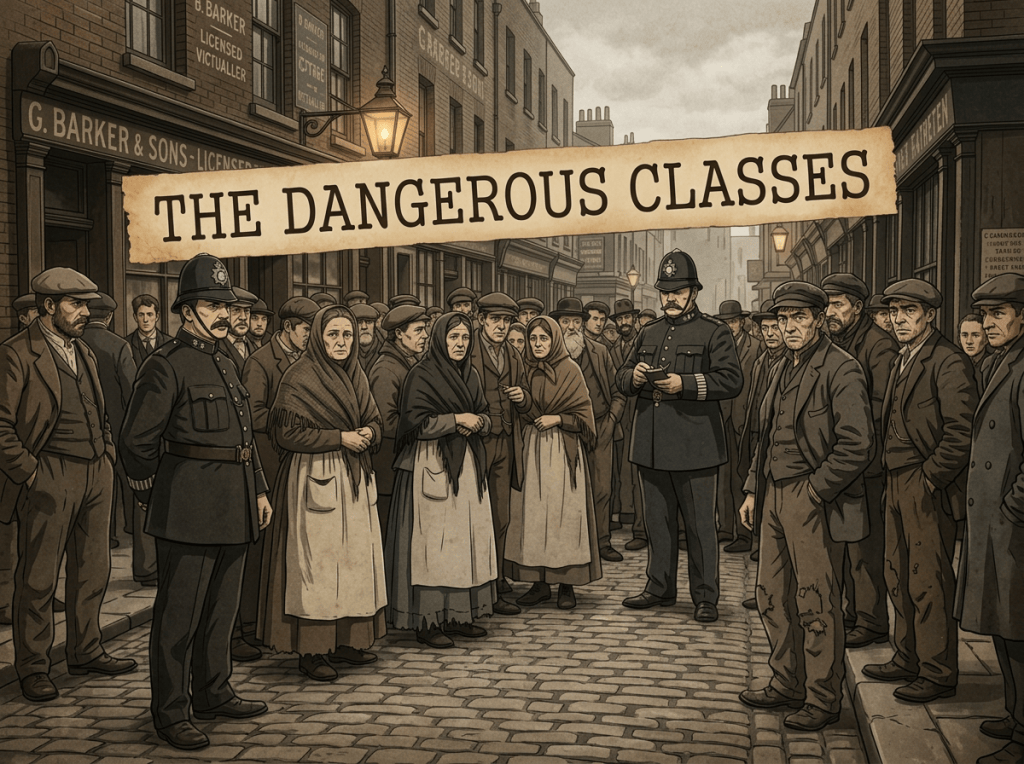
O.4 — The Dangerous Classes: How Victorian Britain Invented an Internal Enemy (Part 1)

Victorian crowd labeled dangerous classes under scrutiny

“The ignorant classes are the dangerous classes.” — Henry Ward Beecher

When Poverty Became a Threat

By the mid‑nineteenth century, Britain was changing fast, and in ways that made those who ran the country uneasy. Industrialisation pulled millions into growing cities, factories, docks, and workshops created huge concentrations of poor workers living in overcrowded neighbourhoods where housing was scarce, sanitation was poor, and work was insecure. These conditions weren’t random failings, but outcomes of an economic system that while extracting wealth from the labour of the poor, mainly generated wealth for those at the top, leaving those at the bottom facing poverty.

Early industrial Britain factories crowded urban neighborhoods

But Victorian elites rarely saw it that way. Instead of blaming the conditions created by industrial capitalism, they blamed the people living in them. A new idea began circulating through politics, newspapers, charity reports, and early police manuals: the concept of the “dangerous classes.” It wasn’t about crime statistics per se, it was essentially a worldview that cast large parts of the working population as naturally deviant and a threat to order.

The poor were not labelled dangerous because of what they did, but because of what they were assumed to be. And once that assumption took hold, it justified everything that followed — more policing, intensified surveillance, treating poverty as personal failure, and the systematic deflection of attention away from the structural conditions that produced it.

Before race became a central organising category of threat in Britain, class played that role. Racialisation would later be added to this framework, but the domestic blueprint was already in place. This is where modern suspicion‑led policing began.

Inventing the Threat: Who Constructed the “Dangerous Classes”?

The idea of the “dangerous classes” didn’t come from evidence. It was built out of sensational journalism, social‑reformer commentary, early criminology, and political anxiety, produced by writers whose accounts of the urban poor carried huge cultural weight because they looked like fact‑gathering rather than judgement, and were treatd as neutral observation.

Victorian newspapers and criminology notes shaping urban fear

Henry Mayhew’s London Labour and the London Poor (1851) offered vivid, ground‑level detail on working‑class street life. He combined sympathy for the people he interviewed with a framework that treated them as a separate social type — distinct from the respectable working class and defined by their relationship to work and moral behaviour. His work was groundbreaking, hugely influential, and helped cement the idea that there was a specific group whose way of life was inherently problematic.

A generation later, Charles Booth’s Life and Labour of the People in London did something similar. While his poverty maps were a landmark in social research, they also reinforced the assumption that certain districts and populations were naturally disordered rather than shaped by structural disadvantage.

These ideas were reinforced by phrenologists and physiognomists, practitioners of pseudosciences that claimed they could read character, intelligence, and criminal tendency from skull shape or facial features. Their work appeared in respectable journals and early criminological studies, giving the idea of a naturally criminal type the appearance of scientific legitimacy. These fields have long been discredited, but they left a lasting mark: the belief that some bodies are inherently more dangerous or deviant than others. The same assumption that, as the last chapter (O.3) showed, was being applied with devastating force in colonial settings.

Together, these writers and thinkers portrayed the urban poor as a semi-criminal demographic — morally weak, undisciplined, lacking self-control, and prone to vice. Their accounts exaggerated disorder, blurred the distinction between poverty and criminality, racialised Irish migrants and early Black communities in Britain’s port cities, and described working-class youth through language that owed as much to colonial vocabulary as to domestic observation. “Street Arabs” — a term applied to homeless street children that embedded racial othering directly into domestic class discourse — sat alongside “roughs” and “natural delinquents” as labels that marked certain children as threats before they had done anything at all.

Seven boys in old-fashioned clothes talking with three policemen on a Victorian street
A group of boys stands on a cobblestone street facing police officers in period clothing.

The category that emerged from this body of work lumped vagrants, street sellers, sex workers, seasonal labourers, homeless children, Irish dock workers, and Black seafarers together into a single undifferentiated threat. The logic was simple and self-reinforcing: poverty produced vice, vice produced disorder, disorder produced criminality. Once accepted, this chain made it easy, and apparently rational, to treat whole communities with suspicion long before any individual within them had done anything wrong.

Policing Poverty: How the New Police Turned Suspicion Into Strategy

The creation of the Metropolitan Police in 1829 (as established in chapter O.1), coincided with the rise of dangerous classes thinking, and the two developments reinforced each other in ways that shaped British policing for generations. The new police took on a mission that went well beyond responding to crime: they were to prevent trouble before it emerged, managing the populations identified as dangerous rather than simply prosecuting individuals who had committed specific offences.

Four Victorian police officers walking on cobblestone street holding lanterns and batons
Victorian police officers on patrol

In working-class districts, this meant constant patrolling, early stop-and-question practices that were the direct predecessors of modern stop and search, and surveillance of the spaces where the poor gathered — pubs, docks, lodging houses, markets, and street corners. Officers made arrests for “idleness,” “loitering,” and “vagrancy,” offences that required no evidence of harm, only a judgment about a person’s type and presence. Gatherings of working-class men were dispersed, and Irish communities were monitored as inherently disorderly. Working-class recreation was policed as a potential precursor to unrest.

Victorian police regulating street behavior at night
Stop and Question in the 1800s Preceded Modern Day Stop & Search

Victorian police manuals openly instructed officers to watch “untrustworthy” areas, intervene in “suspicious behaviour,” and treat the presence of certain populations in certain places as sufficient grounds for attention. The goal was not primarily prosecution, it was presence, pressure, and pre-emptive control. The maintenance of a visible authority capable of managing populations imagined as permanently on the edge of disorder.

This is where unequal police discretion took deep root in British policing. The poor became a population to be watched, managed, and contained. The assumption that certain communities required policing because of what they were assumed to be became embedded in operational practice, in police culture, and in the political common sense of the era. When Britain later turned its colonial gaze more explicitly inward, it did not need to build a new system. It just added race to one that already existed.

Bridge: Part 1 → Part 2

Part 1 has shown how Victorian Britain constructed the idea of the “dangerous classes” — a population imagined as inherently deviant, morally weak, and naturally prone to disorder. But identifying the category is only the beginning. The deeper question is what that idea produced once it entered law, policing practice, and the cultural common sense of the state.

Part 2 examines those consequences directly. Not as abstract theory, but as the operational foundations of British policing.

Part 2 explores:

  • how policing became concentrated in poor and marginalised areas
  • how poverty itself was criminalised through law and discretion
  • how early disproportionality fused class suspicion with emerging racialisation
  • and how these dynamics shaped community–police relations for generations

From the invention of the category to the world it created.

About the Series

By Daniel Davis | Researcher and Commentator on Policing and Social Justice. 

Continue to Part 2 — The Colonial Connection: Mutual Reinforcement

Explore The Full Series: Governing Through Crisis
Follow & Subscribe: LinkedIn | Bluesky | Twitter