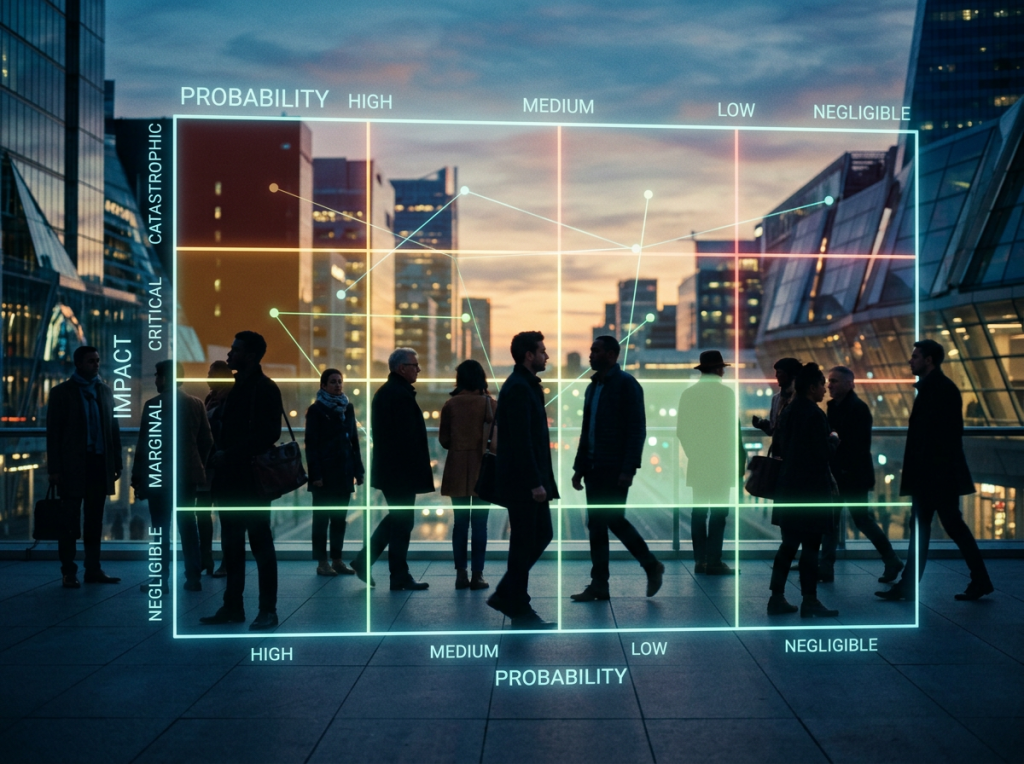
Instinct is just memory you’ve forgotten you learned. — Daniel Davis
How Racialised Instincts Operate in Practice”
By the late twentieth century, racialised assumptions in British policing no longer needed to be explicitly stated or consciously held. They had become common sense; the background against which policing decisions were made, and water in which the institution swam. Understanding how that happened is as important as understanding where it began.
Parts 1-3 traced the construction of race as a governing technology in colonial contexts and its transfer into domestic institutions. This next parts examine what happened next: how colonial categories became embedded in professional culture, how they found new expression in digital tools, how they were sustained by broader cultural narratives, and, crucially, how communities and practitioners have challenged and resisted them. Because the history of racialised policing is not only a history of harm, it’s also a history of refusal.
When Bias Becomes Instinct
Officers routinely describe relying on gut feeling, street sense, and experience. The accumulated professional judgment that comes from years of practice. This kind of tacit knowledge is real and valuable, but it is never neutral. Instincts are shaped by the culture in which they are learned, and if the culture of an organisation frames certain groups as inherently suspicious, then what feels like intuition is, in part, what the institution has passed down.
This is the mechanism by which colonial assumptions become professional common sense. A young officer absorbs informal guidance — “keep an eye on that area,” “that group is known for trouble” — not as ideology but as local knowledge, the kind of thing you learn on the job. The racial logic embedded in those phrases is rarely visible to the person transmitting them, because it has long since ceased to feel like a choice. It feels like experience. And experience, in policing culture, carries considerable authority.

The same process operates at the level of interpreting disproportionality. When police stop and search significantly more Black people than white people in a given area, the institutional tendency is to read that disparity as evidence of where crime is, as rational resource allocation, as demand-led deployment. The underlying assumption — that some demographics are inherently more criminal — is rarely examined, because it has been so thoroughly naturalised. Its colonial origins are invisible precisely because it has been reproduced, without interrogation, across so many institutional generations.
The most powerful structures are often the quietest. When racial bias is never explicitly named, challenged, or confronted, it becomes invisible to insiders, normalised in decision-making, reproduced without intent, and defended as common sense whenever it’s questioned from outside. This is how the legacy of empire sustains itself: through the institutional silence that allows inherited assumptions to pass unchallenged from one generation of officers to the next.
Everyday Policing as the Afterlife of Empire
Most public attention to racialised policing focuses on exceptional moments auch as scandals, viral videos, or public inquiries. But the more consequential continuities are quieter, and live in the routine texture of everyday policing encounters.
Across Britain, officers describe “suspicious behaviour” in terms that map reliably onto racialised stereotypes: someone “hanging around,” “looking nervous,” “acting like he doesn’t want to be seen,” or “fitting the profile.” These phrases feel descriptive, and grounded in observable behaviour rather than assumptions about identity. But they raise a question the institution rarely asks: what profile? Where did it come from? Who does it describe, and why?

The answers lead back to the colonial doctrine of pre-emptive control, in which racialised groups were monitored not for specific criminal conduct but for imagined tendencies — for being the kind of person who might cause trouble, in the kind of place where trouble was expected. The modern equivalents are the everyday mechanisms that rarely make headlines: who is stopped for vehicle checks, who is asked to account for their presence in a particular space, who is surveilled in shopping centres or followed through transport hubs, who is assumed to be “up to something” on the basis of nothing more specific than being young, Black, and male in a particular postcode.
These are not neutral operational decisions, they’re colonial logics lived in the texture of daily policing — reproduced not necessarily through conscious prejudice, but through the institutional frameworks that make certain kinds of suspicion feel natural and certain kinds of populations feel like legitimate objects of pre-emptive attention.
For how these everyday mechanisms connect to the formal construction of “dangerous” communities, see O.4.
Bridge: Part 4 → Part 5
Part 4 has shown how racialised instincts operate in practice — how inherited assumptions shape encounters, assessments, and operational reflexes. But instinct is only one part of the story. Part 5 examines how these logics become automated and normalised — through digital tools, data systems, and cultural narratives that reproduce historical bias at scale.
Part 5 explores:
- how technology encodes old assumptions into new systems
- how cultural narratives make racialised policing feel like neutral public safety
- and how communities and practitioners have challenged and resisted these logics
From instinct to infrastructure — and from infrastructure to the question of what it would take to change it.
About the Series
Governing The Crisis is written by Daniel Davis: researcher and commentator on social justice and policing.
Continue to Part 5 — The Cultural Backdrop: Belonging, Fear, and the Politics of Otherness
Explore The Full Series: Governing Through Crisis
Follow & Subscribe: LinkedIn | Bluesky | Twitter