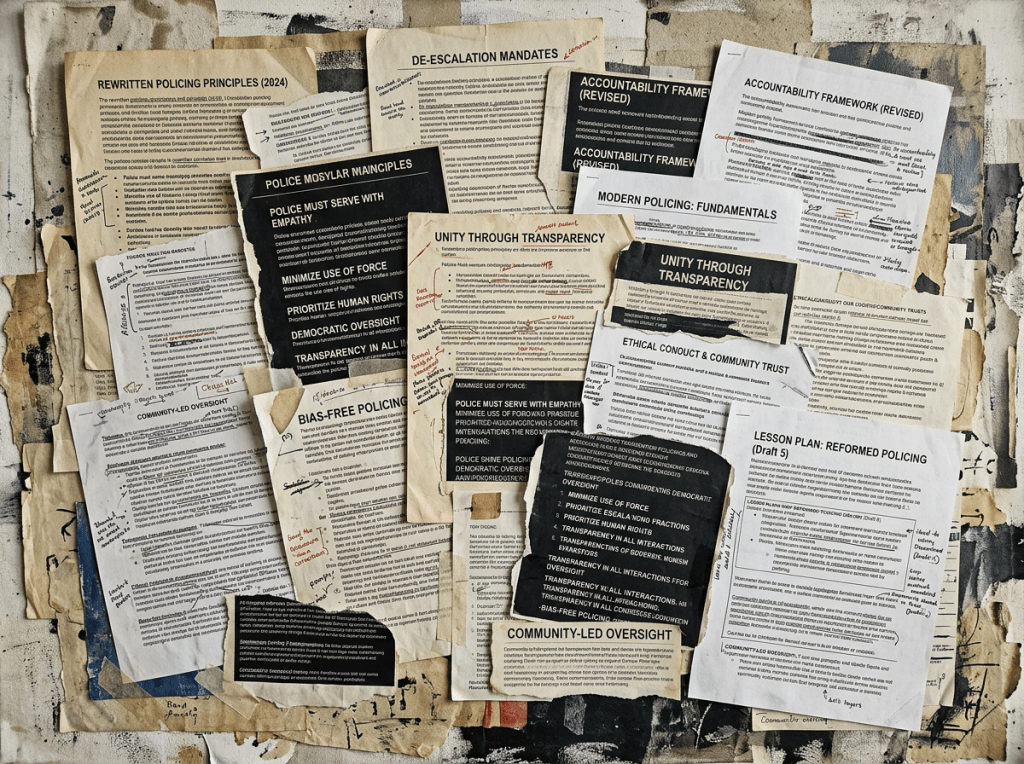
‘The police are the public and the public are the police; the police being only members of the public who are paid to give full-time attention to duties which are incumbent on every citizen.‘ — Instructions to the First Commissioners of the Metropolitan Police, 1829
What if the first job of the police wasn’t safety, but social management?
When the Metropolitan Police Act passed in 1829, it wasn’t the birth of policing, it was a refinement. Britain had had centuries of local, improvised, and often corrupt policing systems, including unpaid watchmen, parish constables, private thief-takers, and the Bow Street Runners. These systems mainly protected property and the powerful rather than the public.
By the time the Metropolitan Police (the Met) arrived, policing was already a tool for managing the poor. What changed in 1829 was the story. The new force was sold as modern, rational, civilian, and rooted in public trust — a clean break from the army. This story still appears in training materials, political speeches, and international comparisons.
But the historical record tells a different truth. The Met was designed to manage the working class, protect property, and stabilise a society in rapid transformation. Consent made for good politics. Control was the actual work.
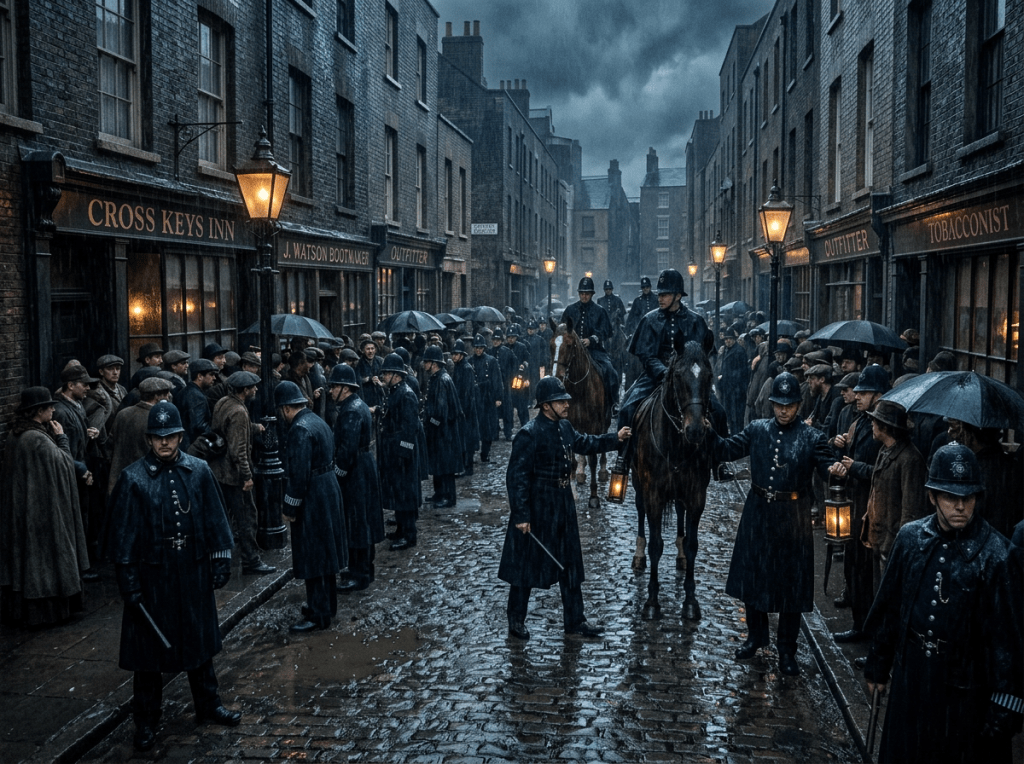
The Peelian Myth: A Story Built After the Fact
The famous Peelian Principles now treated as the moral foundation of British policing, were not written by Robert Peel. They were assembled later by historians, reformers, and senior officers, pieced together from speeches and political rhetoric. Peel’s real agenda was more practical. He needed to pacify an anxious middle class, reassure Parliament that the new force wouldn’t become a militarised garrison, persuade urban workers that street patrols were for their benefit, and simultaneously contain the very populations whose trust was being invoked. These weren’t contradictory goals, but the same goal pursued through different means.
Peel borrowed heavily from earlier models including the Bow Street Runners and the Thames River Police. Both of which were created to protect economic interests, not to serve the public.
Public Resistance Was Immediate
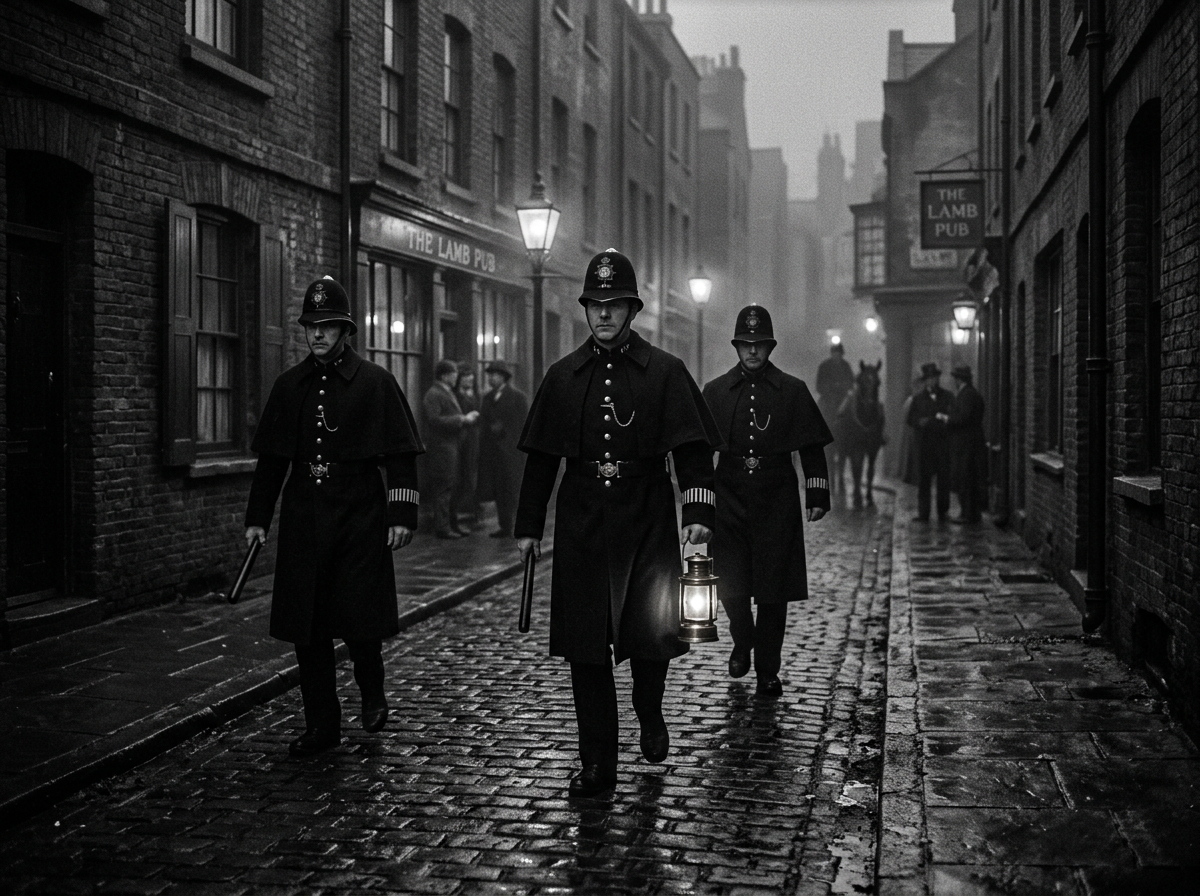
When the Met launched, police officers were not greeted as guardians. Londoners understood the new force as a permanent, centralised system of surveillance and order, directed at them.
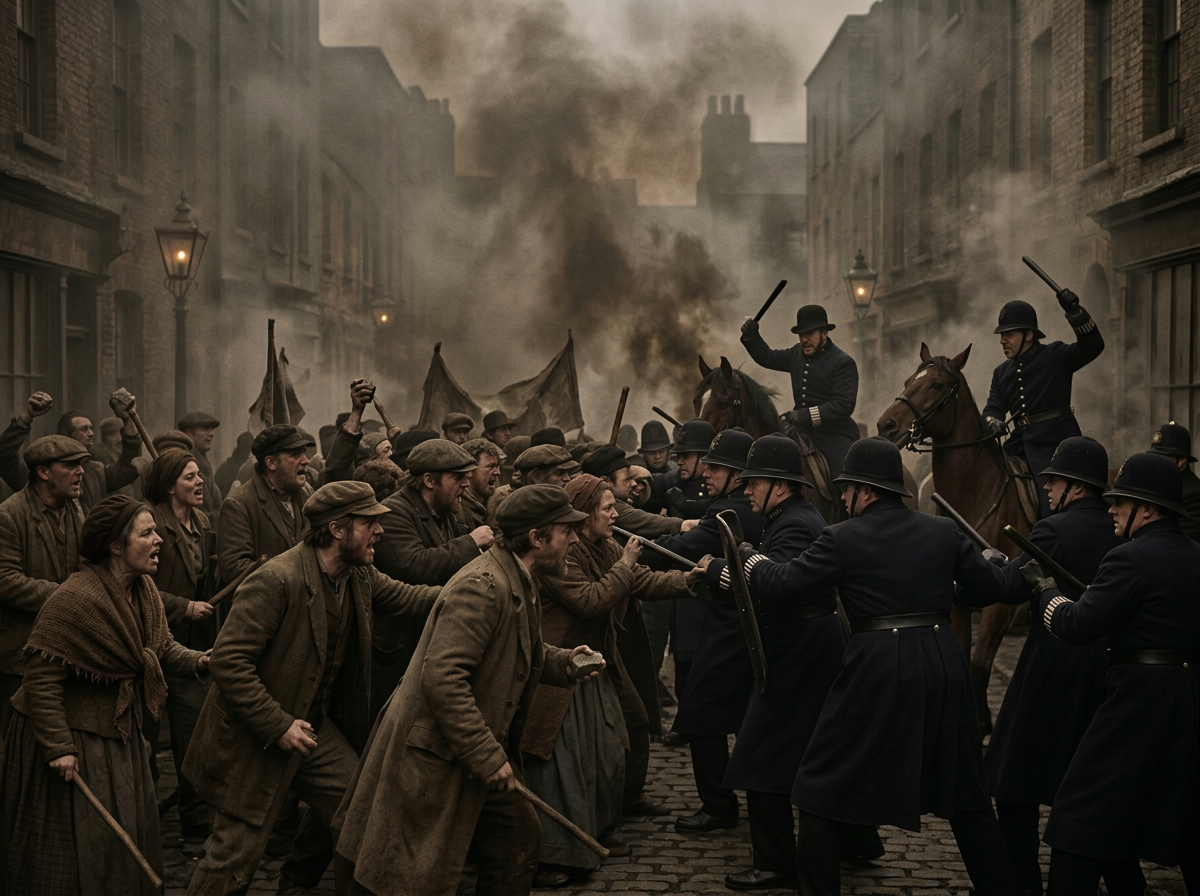
Early newspapers accused the Met of harassment, brutality, political intimidation and of targeting the poor. On the streets, officers were beaten, mocked, and mobbed. The public saw uniformed strangers carrying state authority and batons, and pushed back.
Why the Met Replaced the Army
The state didn’t replace soldiers with police because it embraced democratic principles, it did so because police were more practical. They were cheaper, more acceptable, less politically risky, able to operate continuously, and capable of using force in a more calibrated, deniable way
Peterloo had shown that military violence was a political liability. The Met offered something more sustainable: coercion that looked like order‑keeping. This solved a political problem, not a criminal one.
Policing as Social Management: Who Was Being Controlled?
The police didn’t spread evenly across London, their presence was concentrated in the places where elites believed disorder was most likely, including crowded industrial districts, busy markets, pubs, docks, Irish neighbourhoods, lodging houses, and spaces where working-class youth gathered.
This wasn’t accidental, it was design. The founding logic rested on a straightforward division that some populations were to be watched; others were to be protected. Surveillance and control targeted those imagined as dangerous. Safety was reserved for those with property and status.
The First Stop‑and‑Question Regime
Long before stop and search became a formal legal power, it was practised informally. Victorian police officers were encouraged to challenge, question, and disperse anyone who loitered, gathered in groups, moved unpredictably, or looked out of place. In practice, this meant anyone who was young, poor, Irish, or travelling.
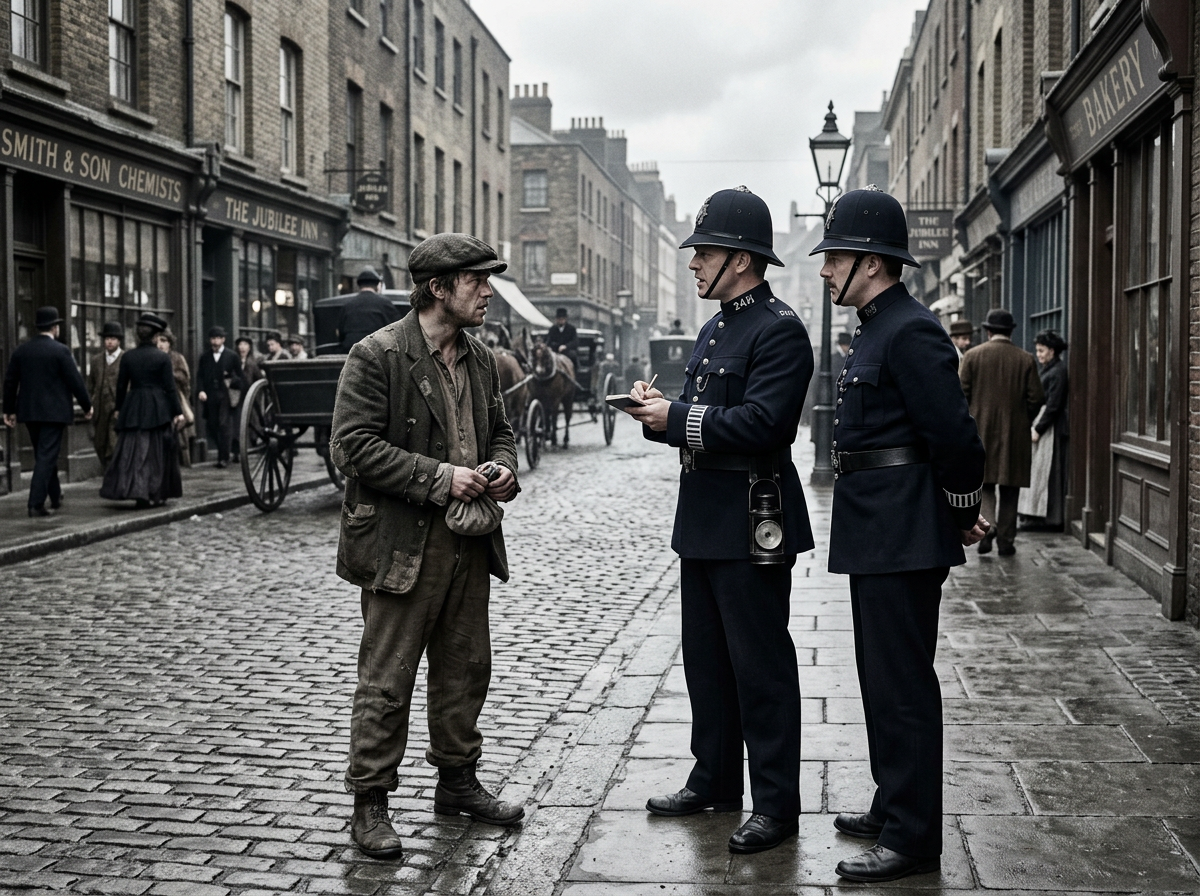
These weren’t criminal indicators, they were social judgments. Suspicion became a tool of governance, a way of keeping certain populations under constant watch.
Public Order Work Was the Core Mission
Despite the rhetoric of crime prevention, early policing was overwhelmingly focused on managing social life, including:
- breaking up assemblies
- dispersing crowds
- controlling fairs and festivals
- monitoring radicals
- supervising elections
- observing public houses
- deterring strikes
Public order did not mean safety, it meant predictability: predictable workers, predictable streets, and predictable politics.
Why the Poor Became “Risks”
The poor were not more criminal, but they were more visible, as much of their life, working, socialising, waiting, moving, gathering, took place in public. Visibility made it easier for the police to classify, and therefore manage them.
The Police read everyday survival as signs of danger, gatherings as gangs, mobility as evasion, communal life as disorder, and poverty itself as pathology. These interpretations became the foundation of early risk thinking; embedding suspicion into how policing understood its own purpose from the very beginning.
For how racialised populations were later read through the same logic, see O.3.
Consent or Coercion? Rethinking the Peelian Myth
The phrase policing by consent only became dominant in the twentieth century, long after the creation of Metropolitan Police. Scholars and senior officers compiled Peel’s scattered statements and reconstructed them into a coherent doctrine. It was a significant act of institutional storytelling which gave the system a moral foundation it did not originally have. But the early reality was far less flattering:
- the police were widely despised
- force was routine
- class was policed before crime
- dissent was managed, not heard
- tactics borrowed from empire shaped domestic practice
This wasn’t a rough patch before the institution found its values. It was the institution operating as designed
The Peelian myth endures because it’s useful. It frames Britain as exceptional, making policing appear neutral, and positions resistance as irrational. Most importantly, it makes present‑day problems look like deviations rather than features built into policing from the start.
The real question the myth obscures is a simple one: if policing was truly rooted in public consent, why were so many of its founding tactics — patrol, surveillance, selective enforcement, public order management — built around controlling the working class, rather than serving them?
Consent was the story —Control was the structure
For generations, “policing by consent” has been held up as Britain’s defining contribution to modern law enforcement. A story of trust, restraint, and public approval. But the historical record shows something different.
The Met were created to stabilise society for those who already controlled it. The narrative of consent gave this project a moral language, and control gave it structure, but beneath that language, the institutional logic has remained consistent. This is why patterns such as who is watched, where power is applied, and what counts as disorder, have proved so enduring.
The gap between the story a system tells about itself and the way it actually operates isn’t unique to the nineteenth century. Understanding where the gap opened between story and structure is part of understanding why it persists today.
Bridge to Part 3
Part 2 has shown how the Metropolitan Police legitimised itself through a story of consent. A story built retrospectively and used as political cover ever since.
But the myth was only the public face. Behind it, the institution was developing something more durable: an operational logic for governing populations who were never meant to be asked for consent.
Part 3 examines:
- how policing shifted from responding to disorder to pre‑empting it
- how moral regulation extended police authority into everyday life
- how suspicion became a governing tool
From the story policing told about itself to the machinery it built beneath it.
Next:
Continue to Part 3: Myths, Motives, and the Machinery of Control
Explore the Full Series: Governing Through Crisis
Read the Book: Ebook | Paperback | Hardback
Follow & Subscribe: LinkedIn | Bluesky | Twitter | Substack
