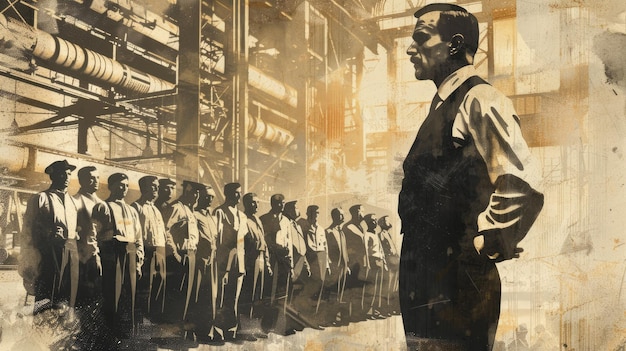
Suspicion became a category. Communities became risks. — Daniel Davis
Empire Within: Internal Colonies and the Policing of Suspicion.
What happens when a state decides that certain people are dangerous before they’ve done anything wrong?
This question isn’t new, didn’t originate with gang databases, Prevent referrals, or predictive policing software, and was answered systematically and with lasting consequences, by Police on the streets of industrial Britain.
This part examines three interlocking developments that shaped British policing from its earliest years: the control of labour, the regulation of morality, and the normalisation of suspicion as a governing tool. Together, they produced something that would outlast the Victorian era. The idea that certain people could be policed for what they might do, rather than anything they had done.

The Workplace Was Political
By the early nineteenth century, Britain’s cities, transformed by industrialisation, created new kinds of work, new concentrations of people, and new forms of collective identity. Factories, docks, mills, and workshops weren’t simply places of production, but political spaces where workers met, organised, shared information, and built solidarities across class and neighbourhood lines.
To industrialists and political elites, this looked like volatility. To the new Metropolitan Police (the Met), it looked like a mandate.
From Riot Suppression to Everyday Regulation
Before the Met, disturbances were handled by magistrates and soldiers, who intervened only when crisis erupted. The Metropolitan Police introduced something fundamentally different: continuous surveillance, a constant presence, and the authority to intervene at much lower thresholds of behaviour.
This shifted labour control from reaction to prevention. Police didn’t simply respond to strikes, they monitored them, pre-empted them, and disrupted them before they could gain momentum. They patrolled work sites, regulated movement, and enforced employer-defined rules about time-keeping, loitering, and access. Much of this was unofficial, but all of it was intentional.

In police records of the period, working-class organisation was consistently framed in terms including unlawful assembly, suspicious congregation, potential violence, disturbance of the peace, that required no evidence of actual harm. These were interpretations of mood, atmosphere, and class rather than descriptions of conduct. The language was discretionary by design, giving officers wide room to interpret behaviour
Policing became a mechanism for managing labour relations and maintaining the social order without ever having to name it as such. That early discretionary vocabulary is the direct ancestor of terms used in policing today such as “risk groups,” “pre-criminal space,” “proactive policing,” or “intelligence-led prevention.” The words have changed, but the logic has not.
For how these logics later shaped the policing of racialised labour and migrant workers, see O.3.
Policing as Moral Regulation: Discipline, Respectability, and Social Order
Victorian policing extended well beyond criminal law, reaching into everyday behaviour, and regulating conduct according to middle-class standards of respectability. Many early arrests were for behaviour that, rather than dangerous, was simply disorderly by elite standards, including drunkenness, vagrancy, rough sleeping, street selling, public affection, gambling, and homelessness. These weren’t treated as crimes in any modern sense, but as visible signs of moral failure.

The police drew a sharp distinction between the deserving poor and the undeserving poor, which borrowed directly from poor law ideology and colonial thinking. The deserving were compliant, sober, and settled, while the undeserving were mobile, disruptive, and disrespectable. Policing targeted the latter because their behaviour violated the norms of those who designed the system, rather than because they posed a greater criminal risk.
Women were policed as symbols of public morality in ways that men were not. Their behaviour was scrutinised more intensely, their bodies treated as sites of public regulation, and their respectability made a condition of their safety. These patterns did not disappear with the Victorian era, their descendants are visible today in victim-blaming narratives, credibility assessments in sexual violence cases, the adultification of Black girls, and the differential policing of sex workers. Gendered policing deserves fuller treatment than a single paragraph allows, and will be returned to across the series.
When early police talked about order, they meant quiet streets, visible deference, and conformity to middle-class norms. Order meant the absence of challenge, not the presence of safety. This moralised understanding of public space laid the groundwork for modern policing of anti-social behaviour, problem families, and community tensions. Categories that continue to blur the line between criminal conduct and social difference.
For the rise of moral panics and media-driven narratives built on similar foundations, see O.4 and Volume I.
Criminalisation Without Crime: How Suspicion Replaced Evidence
Perhaps the most consequential and least acknowledged feature of early British policing is that it normalised intervention based on suspicion rather than evidence. The new police did not wait for crimes, they prevented, predicted, and pre-empted them. And in doing so created a new legal and cultural category: the person who is suspicious but not guilty.

Suspicion required no facts, no evidence, and no harm. At home, it was rooted in appearance, class markers, neighbourhood, mannerisms, poverty, and mobility. In Britain’s colonies, it was explicitly rooted in race. Officers were instructed to identify people who appeared likely to offend, were of suspicious demeanour, had no visible means of subsistence, or frequented disorderly places. Rather than describing behaviour, these criteria described a type of person.
The system this created was simple and self-reinforcing: profile the person, predict the likelihood of harm, and intervene early. Risk replaced wrongdoing, and prediction replaced proof. Once suspicion is institutionalised in this way, disproportionality, the pattern by which some communities are policed far more heavily than others, doesn’t require individual prejudice to operate, and is built into the method itself.
The Invention of the “Pre‑Criminal” Person
The most lasting outcome of this shift was conceptual. Victorian policing imagined a new kind of person. Someone who could be governed for what they might do, instead of what they had done. This folk devil, the pre-criminal person, became a permanent feature of British policing culture.
Its modern descendants are familiar to anyone working in policing, education, youth work, or community safety. The gang-affiliated teenager who has committed no offence, the radicalising student referred to Prevent on the basis of a conversation, the anti-social child whose behaviour is treated as a precursor to future criminality, the high-risk protest organiser placed under surveillance before any law is broken, and the problem family whose children are monitored from birth.

In each case, the logic is the same one established in the nineteenth century: identity and circumstance replace conduct as the basis for intervention. Policing moves from addressing behaviour to managing populations.
For practitioners, this is worth pausing on. When a referral is made, a risk assessment completed, or an intelligence log updated on the basis of who someone is rather than what they have done, that decision sits within a tradition that is nearly two hundred years old. Recognising the architecture doesn’t make the decision wrong, but makes visible what is otherwise hidden in the routine of professional practice.
For how suspicion, labour control, and moral regulation became racialised through empire, see O.3; for the dangerous classes framework that formalised these ideas, see O.4.
Conclusion: The System Before the System
Parts 1, 2, and 3 of this chapter have traced the founding logic of British policing across three interlocking layers. First, the material conditions that made a new form of control necessary — industrialisation and the concentration of the working poor. Second, the political machinery that gave that control a respectable face — the Peelian myth of consent and the language of public service. And third, the operational logic that made control routine, including labour management, moral regulation, and the normalisation of suspicion.
Together, these layers produced a system that wasn’t designed to serve the public equally, but to manage those imagined as dangerous. A system that didn’t require bad intentions to function, but that assumptions went unexamined, and that the populations it targeted were understood as naturally risky, rather than institutionally constructed as such.
This is the foundation on which everything that follows is built. The chapters ahead trace how these domestic logics were exported through empire, refined on colonised populations, and returned home carrying new justifications and new targets. The architecture of control established in Victorian Britain didn’t disappear, it evolved.
Bridge to Part 4
Part 3 has shown how the operational logic of early British policing was built through labour control, moral regulation, and the institutionalisation of suspicion. Mechanisms which didn’t produce a system oriented toward equal safety, but toward managing populations deemed risky by design.
But there is a fourth layer to this foundation that is harder to see because it was present before Britain’s cities became visibly diverse. The ideas about who was dangerous, who needed watching, and who posed a collective threat were not only classed, they were also racialised. And they arrived through empire, long before the communities they would eventually target had settled in Britain in significant numbers.
Part 4 explores:
- how racial logic entered British policing through imperial governance before Britain had a visibly multiracial population
- how the Irish became the first large domestic suspect population — and what template that established
- how the racial infrastructure of policing was built into the institution before the communities it would later target had arrived
From the operational logic of control to the racial foundations that determined who would feel its weight most heavily.
About the Series
By Daniel Davis | Researcher and Commentator on Policing and Social Justice.
Continue to Part 4: Racial Foundations: How Empire Shaped the Domestic Blueprint
Explore The Full Series: Governing Through Crisis
Follow & Subscribe: LinkedIn | Bluesky | Twitter